
Flexible Rubber Bellows – Dealer, Supplier & Wholesaler
Jai Bhagwan Trading Corporation is a reliable Flexible Rubber Bellows Dealer, Supplier and Wholesaler, offering rubber bellows and flexible rubber components for industrial machinery, piping systems, hydraulic equipment, automation and other applications where flexibility, movement absorption and component protection are required.
Flexible Rubber Bellows are designed to accommodate movement while protecting connected components from dust, dirt, moisture and other environmental contaminants. Depending on the design, they can also help absorb vibration, compensate for movement and reduce mechanical stress in connected equipment.
What Are Flexible Rubber Bellows?
A Flexible Rubber Bellow is a corrugated or convoluted rubber component that can expand, compress or flex during operation. Its flexible construction makes it suitable for applications where components need protection without restricting their normal movement.
Rubber bellows are commonly used as protective covers, flexible connectors, expansion joints and sealing components in machinery and industrial systems.
Flexible Rubber Bellows – Key Features
- Flexible and lightweight construction
- Allows controlled expansion and compression
- Helps protect moving components from dust and dirt
- Suitable for vibration and movement compensation
- Helps protect shafts, rods, guideways and actuators
- Available in different sizes and configurations
- Can be manufactured using different rubber compounds
- Suitable for industrial and mechanical applications
- Custom sizes can be considered according to application requirements
- Suitable for regular maintenance and replacement requirements
Materials Used for Rubber Bellows
The material should be selected according to the operating environment, temperature, chemicals and type of movement.
| Material | Typical Characteristics | Common Applications |
|---|---|---|
| EPDM | Good weather, ozone and water resistance | Water systems, HVAC, outdoor applications |
| NBR / Nitrile | Good resistance to oils and fuels | Hydraulic and oil-related applications |
| Neoprene / CR | Good weathering and general industrial performance | Machinery, HVAC and outdoor applications |
| Silicone | Suitable for a wide temperature range | Food, pharmaceutical and high-temperature applications |
| Natural Rubber | Good elasticity and abrasion resistance | General industrial applications |
| FKM / Viton | Good resistance to many chemicals and fuels | Chemical and demanding industrial applications |
Material selection should always be based on the actual working conditions rather than choosing a rubber compound only by price.
Applications of Flexible Rubber Bellows
Flexible Rubber Bellows are used across a wide range of industries and equipment.
Industrial Machinery
Used to protect moving shafts, rods, bearings, guideways and other mechanical components from contamination.
CNC Machines
Bellows can be used as protective covers around moving machine components and guide mechanisms.
Hydraulic & Pneumatic Equipment
Used around cylinders, rods and moving components where protection from dust and contaminants is important.
Pumps & Piping Systems
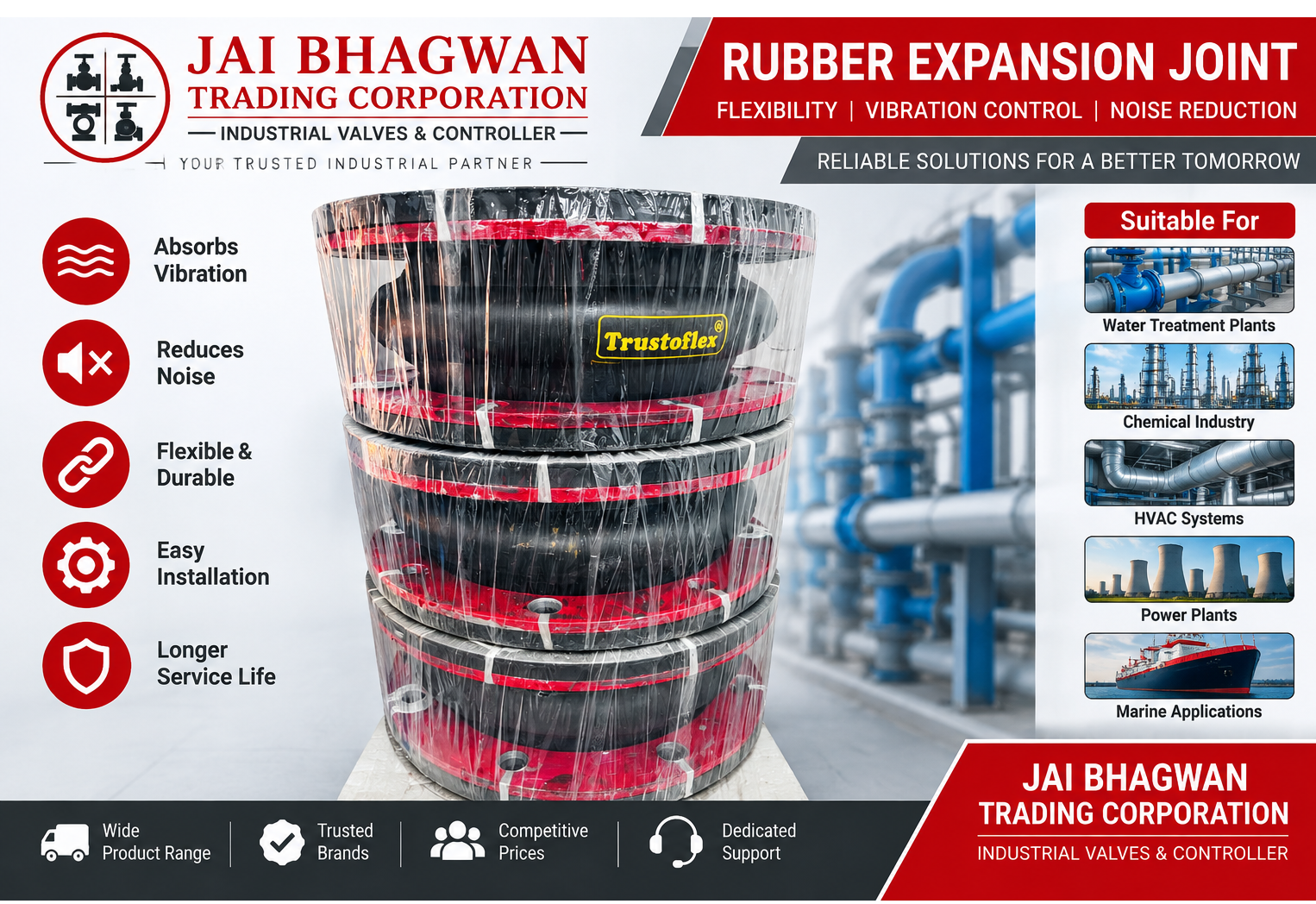
Rubber expansion bellows can accommodate movement and help isolate vibration at pump and piping connections.
HVAC Systems
Flexible rubber expansion joints are commonly used around pumps, chillers, cooling systems and piping to help reduce vibration and accommodate movement.
Automation & Robotics
Flexible bellows can protect moving mechanisms and sensitive components in automated equipment and robotic systems.
Automotive Applications
Depending on the design and material, rubber bellows can be used for protecting joints, shafts and other moving mechanical components.
Flexible Rubber Bellows for Industrial Use
At Jai Bhagwan Trading Corporation, customers can enquire about Flexible Rubber Bellows for different industrial requirements. The appropriate bellow depends on factors such as:
- Overall length
- Inside and outside diameter
- Number of convolutions
- Required movement or stroke
- Compression and extension
- Working temperature
- Exposure to oil or chemicals
- Pressure or vacuum conditions
- Mounting arrangement
- Material requirement
For custom requirements, sharing a drawing, sample, photograph or dimensions can make product selection easier.
Rubber Bellows vs Rubber Expansion Bellows
Although the terms are sometimes used interchangeably, their applications can differ.
Protective Rubber Bellows are generally used to cover and protect moving machine components such as rods, shafts, guideways and actuators.
Rubber Expansion Bellows are commonly used as flexible connectors in piping systems to accommodate movement, vibration, thermal expansion and alignment-related movement.
Why Choose Jai Bhagwan Trading Corporation?
Jai Bhagwan Trading Corporation caters to industrial customers looking for dependable rubber and flexible components.
We support requirements for:
- Industrial machinery
- CNC and automation equipment
- Hydraulic systems
- Pneumatic equipment
- Pumps
- Piping systems
- HVAC systems
- Manufacturing equipment
- Maintenance and replacement applications
Customers can share their required dimensions, existing bellow photograph, drawing or application details to help identify a suitable product.
Frequently Asked Questions – Flexible Rubber Bellows
1. What is a Flexible Rubber Bellow?
A Flexible Rubber Bellow is a corrugated rubber component designed to flex, compress and expand while protecting mechanical components or accommodating movement in a system.
2. What are Flexible Rubber Bellows used for?
They are used for protecting moving components, absorbing movement and vibration, accommodating misalignment and providing flexible connections in machinery and piping systems.
3. Where are rubber bellows commonly used?
They are used in CNC machines, hydraulic cylinders, automation equipment, pumps, HVAC systems, piping systems, manufacturing machinery and automotive applications.
4. What materials are available for Rubber Bellows?
Depending on the application, rubber bellows can be made from EPDM, NBR, Neoprene, Silicone, Natural Rubber and other elastomer compounds.
5. Can Rubber Bellows be made in custom sizes?
Yes. Flexible bellows can be designed in different dimensions and configurations according to the application. For custom requirements, provide the drawing, dimensions or sample details.
6. Can Flexible Rubber Bellows protect machine parts from dust?
Yes. Protective bellows are commonly used to create a barrier around moving components and help protect them from dust, dirt, debris and moisture.
7. Can rubber bellows absorb vibration?
Depending on the design and application, rubber bellows and expansion joints can help isolate vibration and reduce transmission of mechanical vibration.
8. What information is required to order a Rubber Bellow?
It is useful to provide the inside diameter, outside diameter, overall length, number of convolutions, movement/stroke, material requirement and application. A drawing or photograph of the existing bellow can also help.
9. Are Rubber Bellows suitable for oil applications?
Some rubber compounds, particularly NBR, are commonly selected for oil and fuel-related applications. However, material compatibility should be confirmed based on the specific oil, temperature and operating conditions.
10. Are EPDM Rubber Bellows suitable for outdoor applications?
EPDM is commonly selected where weathering, ozone and water resistance are important. The final selection should still consider the complete operating environment.
11. What is the difference between a rubber bellow and an expansion joint?
A protective rubber bellow generally protects moving machine components, while a rubber expansion joint/bellow is commonly used in piping to accommodate movement and help isolate vibration.
12. Where can I buy Flexible Rubber Bellows?
You can contact Jai Bhagwan Trading Corporation, a Flexible Rubber Bellows Dealer, Supplier and Wholesaler, for industrial, machinery and replacement requirements.